Hazardous substance management
Understand substances. Organise workplace protection.
Hazardous substance management starts with substances and activities in your workplace. Substance information, risk assessment, protective measures and staff instruction are considered together; occupational health surveillance remains a separate, confidential task.
Starting point
Look beyond the container to the work itself
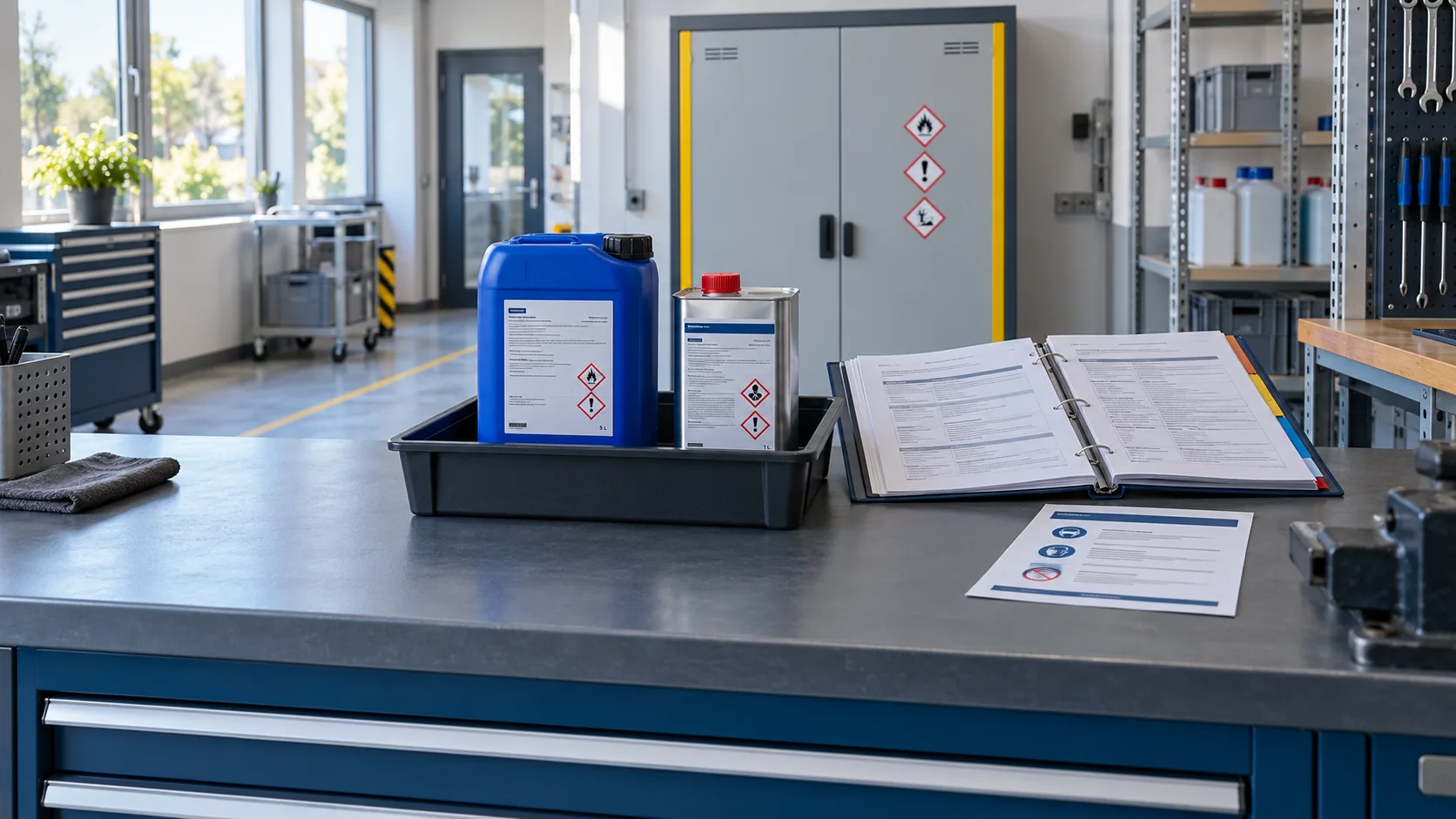
A product name alone does not describe the risk. What matters is how a substance is used and what may be generated or released during work, such as cleaning, processing or maintenance. Skin contact, inhalation and workplace conditions are also relevant.
Start with actual activities and the existing risk assessment. This helps identify missing information, existing protective measures and responsibilities that need clarification.
For an initial discussion, useful information includes the organisational reason, a description of activities and available substance information. We agree the specific scope personally; health information does not belong in this enquiry.
Information
Connect substance information with the workplace
Labels, available safety data sheets and information about use provide important information. They need to be related to workplace activities; a filed safety data sheet is not a substitute for risk assessment.
Where required, a hazardous-substance inventory provides an overview and references the corresponding safety data sheets. Up-to-date information and understandable access help those responsible keep track of changes in work.
Measures
Choose protection according to the risk
First consider whether a hazardous substance or process can be replaced. Further measures concern technical arrangements, work organisation and, where necessary, personal protective equipment. Selection follows the specific assessment, not a standard checklist.
Responsibilities, safe processes and checks of effectiveness need to fit together. The employer retains responsibility; general website information does not replace the workplace assessment.
Understanding
Turn information into understandable action
Operating instructions translate the assessment into understandable guidance for the activity: hazards, protection, conduct and what to do during disruptions or emergencies. Employees need to be able to relate the information to their workplace.
Staff instruction connects this information with actual work and allows questions. Format, language and workplace documentation are matched to the specific context, rather than simply copied from a safety data sheet.
Connection
Clarify surveillance. Preserve medical confidentiality.
Work involving hazardous substances may trigger mandatory or offered surveillance under the conditions in ArbMedVV; surveillance requested by an employee is considered separately. Relevant occasions depend on activities, exposure and the statutory conditions.
Risk assessment, staff instruction and individual medical advice serve different purposes. Personal health information does not belong in an organisational enquiry, the website form or email. Organisational arrangements are discussed separately.
In practice
From the substance to a safer working process.
Identify activities
Review substances, their use and possible releases during work.
Connect information
Relate available substance information to the risk assessment.
Define protection
Agree appropriate measures, responsibilities and staff instruction.
Review effectiveness
Track changes and review findings; consider surveillance separately.
FAQ
Common questions, answered directly.
Is a safety data sheet sufficient for risk assessment?
Labels, available safety data sheets and information about use provide important information. They need to be related to workplace activities; a filed safety data sheet is not a substitute for risk assessment.
Does personal protective equipment always come first?
First consider whether a hazardous substance or process can be replaced. Further measures concern technical arrangements, work organisation and, where necessary, personal protective equipment. Selection follows the specific assessment, not a standard checklist.
Does every hazardous-substance activity require the same surveillance?
Work involving hazardous substances may trigger mandatory or offered surveillance under the conditions in ArbMedVV; surveillance requested by an employee is considered separately. Relevant occasions depend on activities, exposure and the statutory conditions.
Source basis
Sources and further reading.
- German Hazardous Substances Ordinance § 6 – Information and risk assessment Gesetze im Internet
- German Hazardous Substances Ordinance § 7 – General duties and protective measures Gesetze im Internet
- German Hazardous Substances Ordinance § 14 – Information and instruction Gesetze im Internet
- ArbMedVV – Annex: surveillance occasions Gesetze im Internet
Let’s talk